How to Stop Your Dog From Jumping on Guests: Teaching Calm Greetings
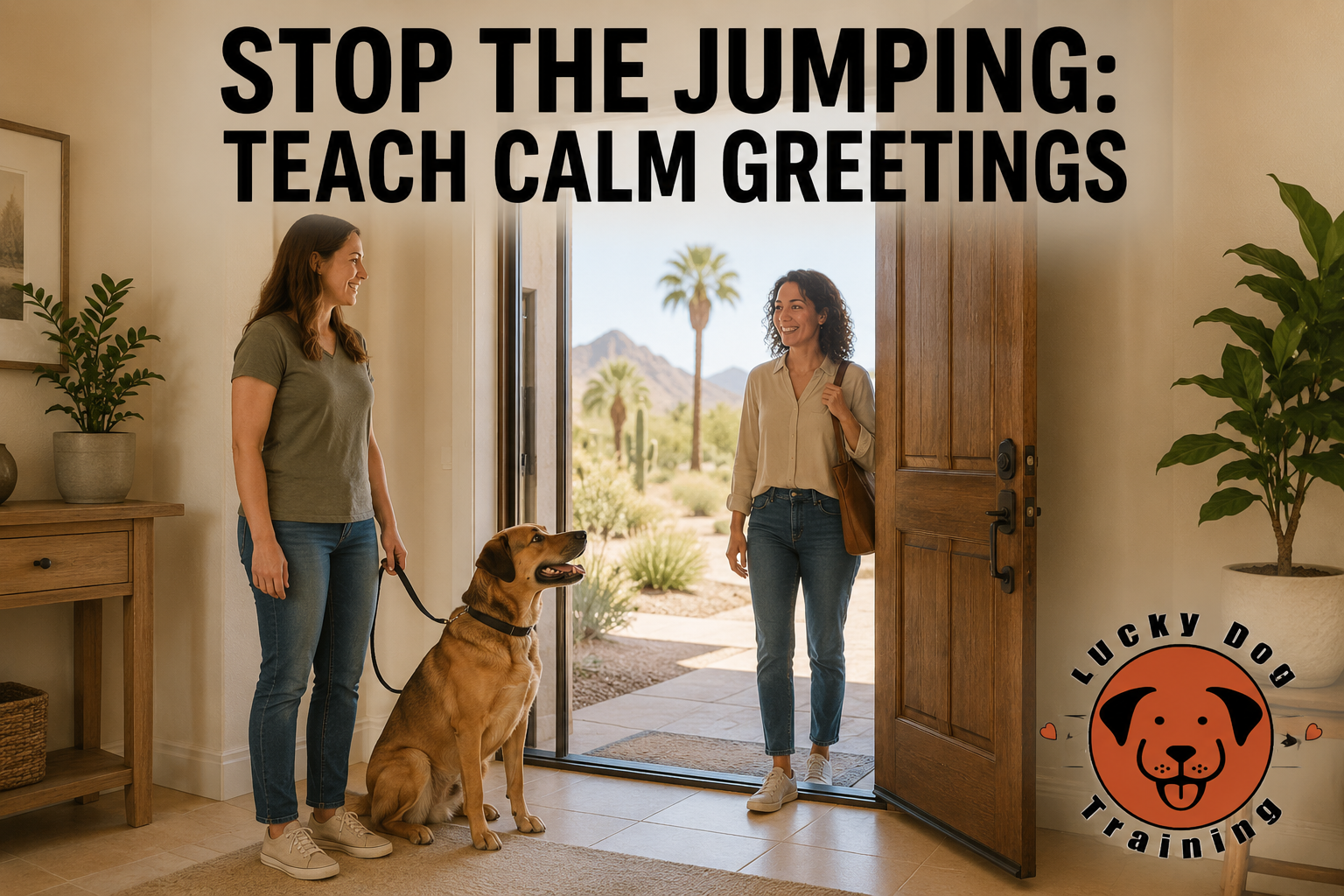
The door opens and your dog immediately launches toward the person entering.
Your guest may be trying to protect their clothing, maintain their balance or politely reassure you that they “love dogs.” Meanwhile, you are attempting to pull your dog away while repeatedly saying, “Down,” “Off” or “Stop.”
Jumping may begin as friendly excitement, but it can quickly become disruptive or dangerous.
A large dog can knock over a child, older adult or person with limited mobility. Even a small dog can scratch someone, damage clothing or make visitors uncomfortable.
Teaching calm greetings is not about making your dog less friendly. It is about teaching your dog how to manage excitement and interact appropriately with people.
Why Do Dogs Jump on People?
Dogs commonly jump because they want to get closer to a person’s face and gain immediate attention.
Jumping may be motivated by:
Excitement
Attention seeking
Greeting behavior
Overstimulation
Frustration
Insufficient impulse control
Inconsistent household rules
A history of being rewarded for jumping
The behavior frequently begins when the dog is young and small.
A puppy jumps up, and people laugh, pet it or pick it up. Months later, the same dog is larger and stronger—but still expects jumping to produce attention.
The dog did not suddenly become disrespectful. It continued practicing a behavior that had worked before.
Attention Can Reward Jumping
Owners often unintentionally reinforce jumping while trying to stop it.
When your dog jumps, you may:
Speak to the dog
Touch or push the dog
Look directly at it
Grab its collar
Repeat its name
Allow the visitor to pet it
Give it a treat to make it move away
From your dog’s perspective, jumping produced a response.
Even negative attention may still be rewarding to a highly social or excited dog.
If jumping sometimes produces attention and sometimes does not, the behavior can become especially persistent. Your dog keeps trying because it has learned that jumping eventually works.
Why Pushing Your Dog Down May Make It Worse
Pushing a jumping dog away can become part of the interaction.
Some dogs interpret physical contact as play. They jump again, the owner pushes again and the encounter becomes increasingly physical.
Other dogs become more stimulated by the owner’s emotional reaction.
The goal should not be to wrestle your dog back to the floor. The goal is to prevent the jump, interrupt the pattern and teach a specific alternative behavior.
Decide What You Want Your Dog to Do
“Don’t jump” does not tell your dog what behavior will earn access to the visitor.
Choose a clear greeting expectation, such as:
Keeping all four paws on the floor
Sitting beside the handler
Remaining on Place
Waiting behind a boundary
Approaching only after being released
Greeting briefly and then returning to the handler
The appropriate expectation depends on the dog, the visitor and the household.
A calm dog may be able to sit near the entrance. A highly excitable dog may need to remain on Place until the initial energy of the arrival has passed.
Use a Leash Before Opening the Door
Do not wait until your dog is already jumping to attempt to gain control.
Before opening the door:
Attach the leash.
Move your dog away from the doorway.
Ask for the selected greeting behavior.
Open the door only while your dog remains responsive.
Close or pause the door if the dog rushes forward.
Allow the visitor to enter without immediately engaging the dog.
The leash should help you communicate and prevent uncontrolled access. It should not become a tool for dragging the dog around the entryway.
A shorter, appropriately managed leash provides clearer communication than several feet of slack that allows the dog to build speed and launch toward the visitor.
Teach Place Away From Real Arrivals
Place training can be extremely useful for controlling door excitement, but your dog should learn the exercise before it is expected to perform during a difficult arrival.
Begin without a visitor.
Teach your dog to:
Go to the designated bed or platform
Remain there while you move around
Stay settled while you touch the doorknob
Remain while the door opens and closes
Hold position during a quiet knock
Maintain control when a familiar helper enters
Increase the difficulty gradually.
If your first practice session occurs when several excited guests arrive, the dog may be too overwhelmed to understand what you expect.
Practice With Planned Visitors
Real-life arrivals can be unpredictable. Structured practice gives you control over the training conditions.
Ask a family member or friend to help.
Begin with a low level of excitement:
The helper approaches quietly.
Your dog performs the expected behavior.
The helper enters without looking at, speaking to or touching the dog.
Calm behavior earns controlled access.
Jumping causes the greeting to pause or end.
Repeat the entrance several times.
Dogs learn through repetition. One carefully planned visitor who enters several times can provide more productive training than waiting for random guests.
The Visitor Must Follow the Rules
Visitors frequently undermine greeting training without realizing it.
They may say:
“It’s okay; I don’t mind.”
“Dogs always love me.”
“He’s just excited.”
“Let me say hello so he calms down.”
Allowing the dog to jump because one person does not mind teaches the dog that the rule changes depending on the visitor.
The rule should remain consistent:
Calm behavior earns access. Jumping delays or removes access.
Ask visitors to avoid eye contact, conversation and touching until your dog demonstrates the required behavior.
Do Not Reward a Jump Followed by a Sit
Timing matters.
If your dog jumps repeatedly and then sits for one second before receiving attention, it may learn a behavioral chain:
Jump, jump, jump, sit, receive attention.
The sit does not erase everything that happened immediately before it.
Prevent the jump whenever possible and reward calm behavior before the dog loses control. Over time, increase how long your dog must remain composed before greeting.
Calm Greetings Begin Before the Doorbell Rings
Dogs that live in a constant state of excitement will have more difficulty controlling themselves when someone arrives.
Everyday structure helps build the skills required for calm greetings.
Practice:
Waiting before going through doors
Sitting before receiving attention
Remaining on Place while people move around
Settling after play
Following leash direction
Waiting before being released from the car
Responding to the handler around distractions
Door manners are not an isolated trick. They reflect the dog’s overall impulse control and responsiveness.
What If Your Dog Is Fearful or Protective?
Not every dog jumps because it wants affection.
Some dogs move toward visitors because they are uncertain, territorial, fearful or attempting to control the person’s movement.
Concerning signs may include:
Stiff posture
Hard staring
Growling
Blocking the visitor
Snapping
Rushing forward and retreating
Inability to disengage
Guarding the doorway or owner
A dog displaying these behaviors should not be handled as a simple friendly jumper.
Avoid forced greetings and seek a professional Behavior Assessment. Safety and appropriate management must come before social interaction.
When Should You Hire a Professional Dog Trainer?
Consider professional help when:
You Struggle to follow the steps outline, or need help in facilitating the steps.
Your dog knocks people over.
Children or older adults visit your home.
Jumping is becoming more intense.
Your dog cannot respond once someone enters.
The behavior includes barking, lunging or growling.
Your dog becomes difficult to control physically.
Family members apply inconsistent rules.
Visitors have stopped coming to your home.
Online advice has not produced lasting improvement.
A professional trainer can evaluate what motivates the behavior, establish an appropriate greeting routine and teach you how to maintain it.
Professional Dog Training in The Coachella Valley
Lucky Dog Training helps owners develop calmer greetings, better household manners, stronger impulse control and clearer communication.
Available programs may include:
Private Lessons
Day Training
Train and Play
Lifestyle Board and Train
Structured owner coaching
In-home follow-up training
Every successful training program begins with a professional Behavior Assessment. Program recommendations and pricing are provided after your dog’s behavior, training history, environment and individual needs have been evaluated.
The best part? Lucky Dog Training provides follow-up sessions at your home regardless of which training program you choose. This allows us to transfer your dog’s new skills directly into the environment where visitors actually arrive.
Call 760-774-0884 or schedule a professional Behavior Assessment.
If you or someone you know could benefit from professional dog training, please share Lucky Dog Training with them.