
Puppy Biting: What’s Normal—and What Must Change
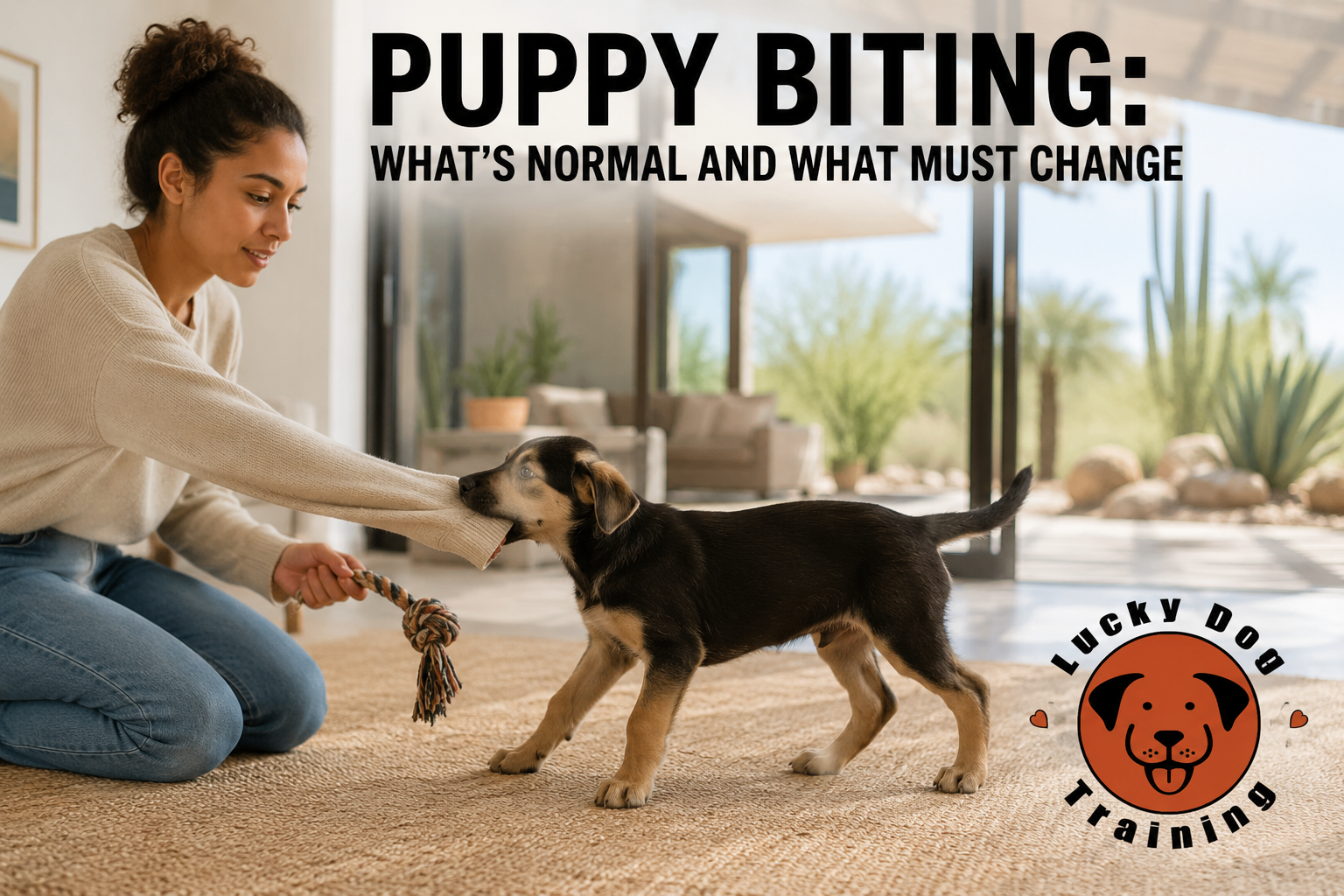
Those tiny puppy teeth can make living with a new puppy feel like living with a small alligator.
Your puppy grabs your hands, bites your sleeves, attacks your pant legs and becomes increasingly mouthy when excited. You offer a toy, but the puppy returns to your skin or clothing seconds later.
Puppy mouthing is normal. That does not mean owners should ignore it or assume every puppy will simply outgrow it.
The habits your puppy rehearses today can influence how it communicates, plays and handles frustration as an adult.
Why Do Puppies Bite and Mouth People?
Puppies use their mouths to explore and interact with their environment.
Common reasons for puppy biting include:
Exploring new objects and textures
Teething discomfort
Initiating play
Seeking attention
Becoming overexcited
Becoming overtired
Responding to fast-moving hands or clothing
Experiencing frustration
Lacking appropriate boundaries
Not yet understanding that human skin is sensitive
Puppies naturally mouth their littermates during play. When one puppy bites too hard, the other puppy may end the interaction or respond in a way that communicates that the pressure was inappropriate.
Once a puppy enters a human household, people must continue teaching appropriate limits.
Is Puppy Biting Aggression?
Most puppy mouthing is not aggression.
Normal play biting generally occurs when the puppy is excited, playful, curious or overstimulated. The puppy’s body is usually loose, active and socially engaged.
However, biting deserves closer evaluation when it involves:
A stiff or frozen body
Guarding food, toys or resting areas
Intense growling accompanied by threatening body language
Repeated bites intended to drive someone away
Extreme fear
Biting when touched or handled
Sudden behavior changes
Bites that repeatedly break skin
Escalation despite consistent training
Pain and medical conditions can also affect behavior. A sudden or concerning change should be discussed with a veterinarian.
A professional Behavior Assessment can help distinguish normal puppy behavior from fear, guarding, handling sensitivity or a developing behavioral concern.
Why Redirecting With a Toy Sometimes Fails
Offering an appropriate toy is useful, but simply placing a toy in front of the puppy does not always solve the problem.
If your puppy bites your sleeve and you immediately begin an exciting game, it may learn:
Biting the person makes the person produce a toy and begin playing.
Redirection works best when it is paired with structure.
The puppy must learn:
Biting people ends access to attention or movement.
Calm behavior allows interaction to resume.
Toys are appropriate outlets for biting and play.
The owner controls when play begins and ends.
The goal is not merely to distract the puppy. The goal is to teach clear rules about how interaction works.
Stop Making Hands and Clothing Into Toys
Fast-moving hands, waving sleeves and feet sliding across the floor can activate a puppy’s desire to chase and grab.
When your puppy becomes mouthy:
Avoid rapidly pulling your hand away.
Stop moving the clothing the puppy has grabbed.
Do not wrestle with the puppy using your hands.
Remain calm instead of becoming louder or more animated.
End access to attention when biting continues.
Resume interaction after the puppy regains control.
Some puppies become more excited when a person squeals or says “Ouch!” loudly. If vocalizing increases the intensity, calmly disengage instead.
Teach That Biting Makes Interaction Stop
Attention is valuable to a puppy.
When teeth touch skin or clothing, calmly stop the interaction. Stand still, remove access to your hands and briefly disengage.
This does not require an emotional confrontation.
Consistency is what makes the lesson clear:
Appropriate play keeps the interaction going.
Biting people makes the interaction stop.
Calm behavior restores access.
If one family member allows rough hand play while another attempts to stop biting, the puppy receives conflicting information.
Every person interacting with the puppy should follow the same basic rules.
Your Puppy May Need Rest—not More Exercise
Puppies often become wild, mouthy and difficult to redirect when overtired.
Owners sometimes interpret this behavior as evidence that the puppy needs even more activity. The puppy is exercised longer, becomes increasingly overstimulated and bites even harder.
Young puppies require considerable sleep. An overtired puppy may:
Run frantically through the house
Grab clothing
Bite repeatedly
Bark for attention
Ignore familiar direction
Become unable to settle
Move from one inappropriate activity to another
A structured potty break followed by calm rest may be more helpful than additional high-energy play.
The crate or designated resting space should not be used angrily as punishment. It can be used neutrally to help the puppy transition from activity into rest.
Build Impulse Control Into Everyday Life
Puppy biting is not only about teeth. It frequently reflects a puppy that has not yet learned how to regulate excitement and frustration.
Begin developing impulse control through simple daily exercises:
Wait calmly before receiving food.
Sit before gaining access to attention.
Pause before going through doors.
Remain on Place for brief, successful periods.
Release a toy when asked.
Settle after structured play.
Follow direction before receiving freedom.
These exercises help your puppy understand that calm, responsive behavior creates access to desired resources.
Use Appropriate Toys Purposefully
Keep suitable toys accessible throughout the home so you can provide an appropriate outlet before the puppy becomes fully overstimulated.
Useful options may include:
Soft tug toys
Durable puppy-safe chew toys
Food-dispensing toys
Textured teething toys
Appropriately sized rubber toys
Supervise your puppy and choose items that cannot be swallowed or easily destroyed.
Tug can be a valuable structured activity when the owner establishes rules. The puppy should learn when the game begins, when it ends and how to release the toy.
Avoid Harsh or Emotional Reactions
Hitting the puppy, holding its mouth shut or responding with anger can create fear, conflict or defensive behavior.
At the same time, owners do not have to tolerate uncontrolled biting and hope it disappears.
Clear boundaries and fair corrections can be communicated without frightening or injuring the puppy. The response must be appropriate for the puppy’s age, temperament and motivation.
Effective puppy training combines:
Prevention
Redirection
Consequences
Appropriate outlets
Calm communication
Structured rest
Consistency
Reinforcement of desirable behavior
No single technique works for every puppy.
When Should Puppy Biting Improve?
Progress depends on the puppy’s age, breed, temperament, activity level, household environment and the consistency of everyone involved.
Teething can increase mouthing during the first several months. However, owners should still see gradual improvement in:
Bite pressure
Ability to redirect
Response to interruption
Recovery after excitement
Independent settling
Understanding of household rules
Waiting until the puppy is larger and stronger can make the habit more difficult to address.
Early training helps prevent normal puppy behavior from becoming an established adult pattern.
When Should You Contact a Professional Dog Trainer?
Consider professional training when:
Your puppy repeatedly breaks skin.
Biting is becoming more intense.
Children or older adults are being injured.
Your puppy guards food, toys or space.
Your puppy cannot settle after excitement.
Handling consistently produces biting.
Redirection works only momentarily.
Family members are becoming afraid or frustrated.
You are unsure whether the behavior is playful, fearful or aggressive.
Professional guidance can help you understand why the biting occurs and establish a training plan appropriate for your puppy and household.
Puppy Training in The Coachella Valley
Lucky Dog Training helps owners establish communication, structure and appropriate behavior before puppy habits become larger adult problems.
Training recommendations may include:
Private Lessons
Day Training
Train and Play
Lifestyle Board and Train
Puppy-development training
Structured owner coaching
Every successful training program begins with an Introductory Call followed by a professional Behavior Assessment. This allows us to understand your puppy’s behavior, development, household environment and training needs before recommending a program.
The best part? Lucky Dog Training provides follow-up sessions at your home regardless of the training program you choose. This helps transfer your puppy’s training into the environment where you actually live together.
Call 760-774-0884 or schedule your Introductory Call.
If you or someone you know is struggling with puppy biting or another training concern, please share Lucky Dog Training with them.