
How to Stop Your Dog From Digging Up the Yard
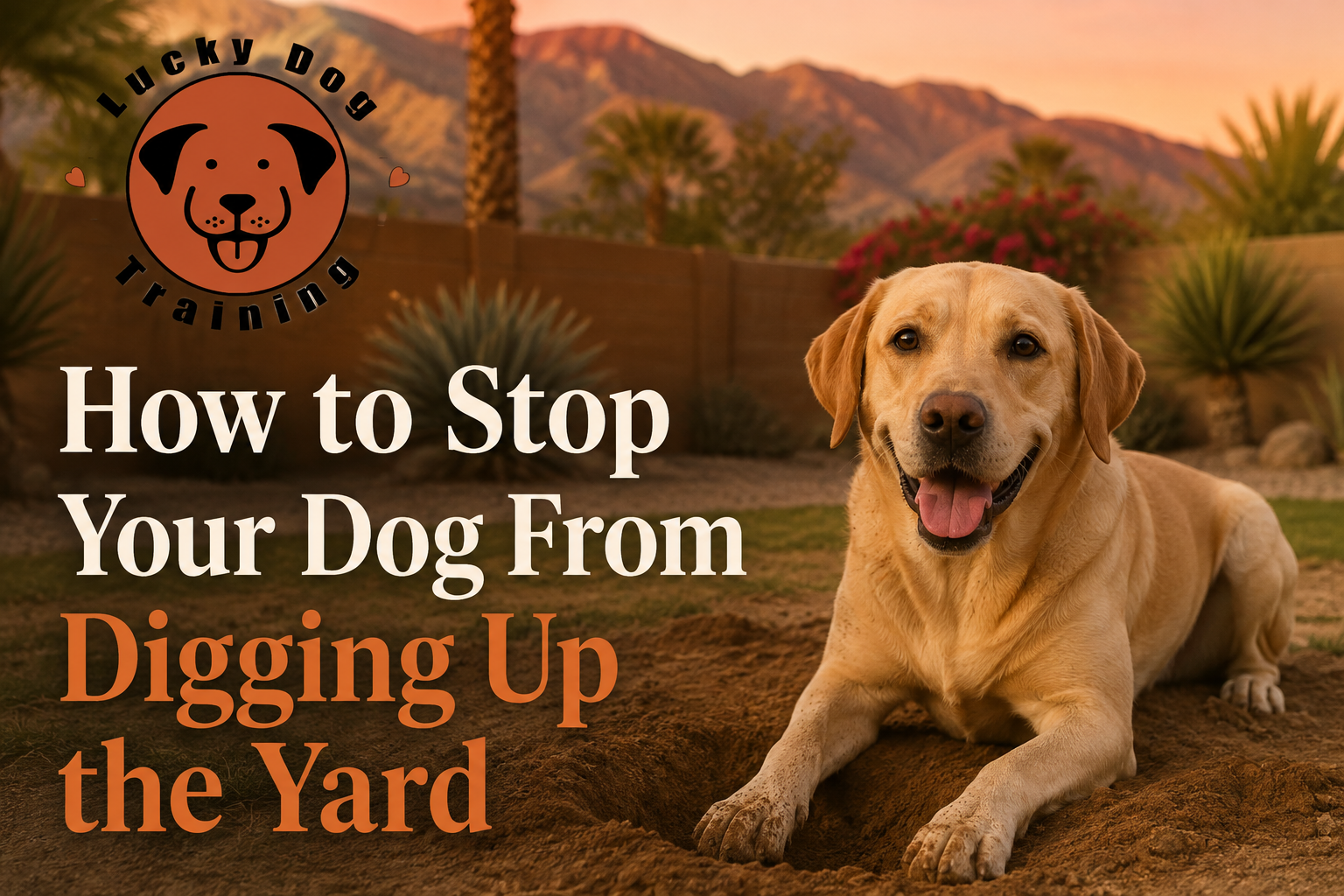
One hole appears beside the patio. Then another shows up under a shrub. Before long, your dog has redesigned the yard without asking permission.
It is easy to see digging as stubbornness or disobedience. Dogs do not dig to ruin landscaping or embarrass their owners, however. They dig because the behavior produces something they value: cooler ground, an interesting smell, an escape route, buried treasure, physical activity, or relief from boredom and frustration.
That distinction matters.
If you only interrupt the paws, you may stop one hole. If you identify what the digging accomplishes and change the entire pattern, you have a much better chance of changing the habit.
Determine what your dog is trying to accomplish
The location, timing, and shape of the hole can provide useful clues.
Digging to cool down
A dog who scrapes away warm surface soil and lies in the exposed depression may be trying to reach cooler ground. In The Coachella Valley, this should be treated as a heat-safety warning—not merely a training problem.
Move the dog into an air-conditioned space, provide water, and evaluate whether outdoor access is appropriate for the temperature and time of day. Training cannot make dangerous heat safe.
Investigating underground movement or scent
Dogs may hear or smell insects, lizards, rodents, irrigation moisture, roots, or other activity beneath the surface. These holes are often concentrated around one area and may become deeper as the dog investigates.
Simply filling the hole does not remove the scent or movement that originally attracted the dog.
Digging along the fence
Fence-line digging may be an attempt to reach something on the other side, follow a scent, escape the yard, or gain access to activity the dog can see or hear.
This pattern deserves immediate management. A successful escape can lead to traffic exposure, heat injury, a lost dog, conflict with another animal, or an encounter with wildlife.
Burying or recovering objects
Some dogs bury chews, toys, or food and later return to retrieve them. The behavior is rewarding because the dog completes a natural sequence: carry, hide, cover, and recover.
If your dog regularly receives valuable items outdoors and is then left alone, the yard may become a storage system.
Making the yard an activity
A dog left outdoors without direction may invent a job. Digging provides movement, scent, texture, and immediate feedback. Every scoop changes the environment, so the behavior can remain interesting long after an ordinary toy has been abandoned.
This is why “my dog has a big yard” is not the same as a complete exercise and training plan. Space provides opportunity. It does not automatically provide purpose.
Digging during stress or frustration
Some dogs dig after being left alone outside, when they cannot reach a person or dog, or when something beyond a barrier causes intense arousal.
Look for accompanying behaviors such as:
Pacing
Whining
Heavy panting unrelated to temperature
Fence-running
Repeated escape attempts
Inability to settle
In these cases, the hole is evidence of a larger pattern. Blocking one location without addressing the dog’s emotional state may simply move the behavior elsewhere.
Digging is self-rewarding
Digging can pay the dog without help from a person. The dog feels the soil move, follows a scent, reaches cooler ground, or releases pent-up energy.
A correction delivered after the hole exists is therefore too late to explain what the dog should do differently next time.
Your dog may associate your frustration with your arrival, your body language, or your presence near the hole. They are unlikely to understand a lecture about something that happened several minutes earlier.
Effective training changes what happens before, during, and after the behavior:
Prevent unsupervised rehearsal.
Identify the function of the digging.
Interrupt the sequence early and calmly.
Give the dog a clear alternative.
Reward that alternative until it becomes the easier habit.
Stop leaving the dog outside to practice
If your dog digs whenever nobody is watching, unsupervised yard access is currently too much freedom.
For now:
Accompany your dog outside.
Use a leash or long line when necessary.
Keep outdoor sessions purposeful and reasonably short.
Bring the dog inside before boredom or heat becomes a problem.
Block access to vulnerable garden beds and fence lines.
Repair gaps and secure gates.
Avoid leaving high-value objects outside if your dog buries them.
Management does not replace training. It protects the training process by preventing another rewarding repetition.
Every new hole strengthens the old routine. Every supervised success gives you an opportunity to build a different one.
Establish a structured yard routine
Many dogs are released through the door and immediately begin making their own decisions. A structured routine gives outdoor access a predictable purpose.
Try this sequence:
Exit the house under control.
Walk the perimeter with your dog.
Allow an appropriate bathroom opportunity.
Practice several minutes of obedience, recall, or engagement.
Release your dog to supervised exploration.
Interrupt interest in forbidden digging areas before paws hit the soil.
Finish with a calm transition back inside.
The routine does not need to turn every bathroom break into a formal training class. It simply teaches your dog that opening the back door does not mean unlimited, unsupervised access to every part of the yard.
Interrupt the sequence early
Digging rarely begins with a fully formed hole. Watch for the steps that come first:
Returning repeatedly to one patch of soil
Intense nose-down investigation
Pawing once or twice
Staring through or beneath a fence
Carrying a chew to a secluded corner
Scratching damp soil near irrigation
Becoming increasingly frantic outdoors
Early interruption is clearer and easier than trying to stop a dog already absorbed in excavation.
Use a known cue such as Come, Leave It, or Place, then guide your dog into a compatible activity. Do not repeat the cue while the dog continues digging.
If your dog cannot respond, reduce the distance, use a leash or long line, and lower the difficulty.
Give your dog an appropriate job
Telling a dog what not to do leaves an empty space. Fill that space with behavior that is safe and repeatable.
Useful alternatives may include:
Following you through a short obedience pattern
Going to an outdoor Place cot
Retrieving a toy under structured rules
Searching for a specific toy above ground
Practicing recall between two people
Walking with you instead of patrolling the fence
Settling near the family during supervised yard time
Choose the alternative based on the cause. A dog digging from boredom may benefit from active engagement. A dog seeking cooler soil needs to go inside. A dog digging to escape needs secure management and a professional assessment of the motivation.
Should you create an approved digging zone?
For some dogs, an approved sand or soil box can be useful. It provides a legal place for a natural behavior instead of attempting to eliminate it everywhere.
An approved zone works best when:
The dog enjoys digging as recreation rather than escape.
The area is safely contained and easy to supervise.
The owner actively teaches where digging is allowed.
Toys are buried shallowly to make the correct location rewarding.
Digging elsewhere is consistently interrupted and redirected.
The soil or sand is maintained with local health considerations in mind.
Do not assume your dog will understand the distinction without training. A sandbox placed in the corner is not self-explanatory.
Walk your dog to the zone, encourage investigation, reward engagement there, and use a clear release. When the dog approaches an off-limits area, redirect them to the approved location.
If disturbed soil is a health concern in your region, ask your veterinarian whether a digging zone is appropriate. A behavioral outlet should never override medical guidance.
A Coachella Valley note about disturbed soil
Digging has an important local health dimension.
Valley Fever is caused by inhaling fungal spores that can become airborne when contaminated soil or dust is disturbed. California public-health guidance notes increased exposure risk when dirt is stirred up during digging, and UC Davis reports that dogs who dig in dirt face increased risk.
This does not mean every hole exposes a dog to Valley Fever, and training advice cannot diagnose or prevent every case. It does mean owners in dry Southwestern environments have another reason to limit unnecessary digging and dusty outdoor activity.
Contact your veterinarian if your dog develops concerning signs such as a persistent cough, fever, reduced appetite, unusual fatigue, lameness, or unexplained weight loss.
Seek veterinary guidance for symptoms, testing, and medical-prevention questions. Use training to address the behavioral pattern that repeatedly disturbs soil.
What not to do
Do not punish the dog after discovering a hole
The timing is too late to teach a clear alternative and may make your dog wary of you near the damaged area.
Do not bury dangerous surprises
Avoid sharp materials, irritants, chemicals, feces, or devices intended to frighten the dog. These approaches can cause injury, contamination, anxiety, or avoidance without teaching the correct behavior.
Do not rely on exercise alone
Appropriate exercise can help when boredom contributes, but it will not resolve digging caused by heat, prey scent, escape motivation, stress, or a long reinforcement history.
The plan must match the cause.
Do not provide unlimited freedom too soon
Freedom should increase when the dog demonstrates reliability. Reopening the entire yard after two hole-free days may restore the old routine before the new one is established.
Do not ignore fence-line digging
Treat escape-directed digging as an immediate safety issue. Secure the environment first. Do not test the dog’s training beside an opening.
A practical two-week reset
For the next two weeks, make yard access deliberate.
Days 1–3: Observe and prevent
Supervise every outdoor session.
Record when and where your dog investigates.
Note heat, time of day, nearby animals, sounds, and preceding activity.
Block vulnerable areas.
Prevent successful digging rehearsals.
Days 4–7: Build the replacement
Practice Come, Leave It, Place, and engagement in the yard.
Reward your dog for moving away from former digging areas.
Add a safe activity that matches the dog’s needs.
Keep sessions short enough for the dog to succeed.
Days 8–14: Add controlled freedom
Increase exploration gradually while maintaining supervision.
Use a long line if your dog still ignores cues at a distance.
Vary the time and part of the yard used for training.
Reinforce calm choices before the dog returns to the old pattern.
Reduce freedom immediately if digging resumes.
Progress is measured by better choices and faster responses—not simply by the absence of a new hole.
When professional training can help
Professional guidance is valuable when your dog:
ANYTIME the steps in our blog posts are out of your ability to follow, or you struggle to facilitate them
Digs repeatedly despite consistent supervision
Ignores recall or Leave It outdoors
Fixates on fence lines, rodents, or neighboring dogs
Attempts to escape
Becomes frantic when left outside
Cannot settle without constant activity
Creates dangerous holes near gates, pools, irrigation, or structures
Displays digging as part of several household behavior problems
Lucky Dog Training evaluates the dog, environment, reinforcement history, and owner’s daily routine before recommending a program.
Training may include reliable recall, Leave It, Place, boundary work, impulse control, structured outdoor access, and owner follow-through around real-life distractions.
Programs include Private Lessons, Day Training, Train and Play, and Extended Training. The right option depends on your dog’s behavior, your household, and your goals.
Start with a consultation. Schedule an introductory call through LuckyDogTrainingPS.com so we can understand what is driving the digging and recommend the most appropriate training pathway.
The best part: Lucky Dog Training provides Follow-Up Sessions AT YOUR HOME no matter which training program you choose.
Digging is shaped by the actual yard, fence, household schedule, wildlife activity, and outdoor routine. In-home follow-up lets us transfer your dog’s skills into the environment where the problem occurs.
Lucky Dog Training serves Palm Springs, Palm Desert, Rancho Mirage, Cathedral City, La Quinta, Indio, and surrounding communities throughout The Coachella Valley, as well as clients across Riverside, San Diego, and Los Angeles counties.
If you or someone you know needs practical help creating a calmer, safer, and more reliable dog, please share Lucky Dog Training.