
Why Dogs Fear Nail Trims—and How to Build Trust
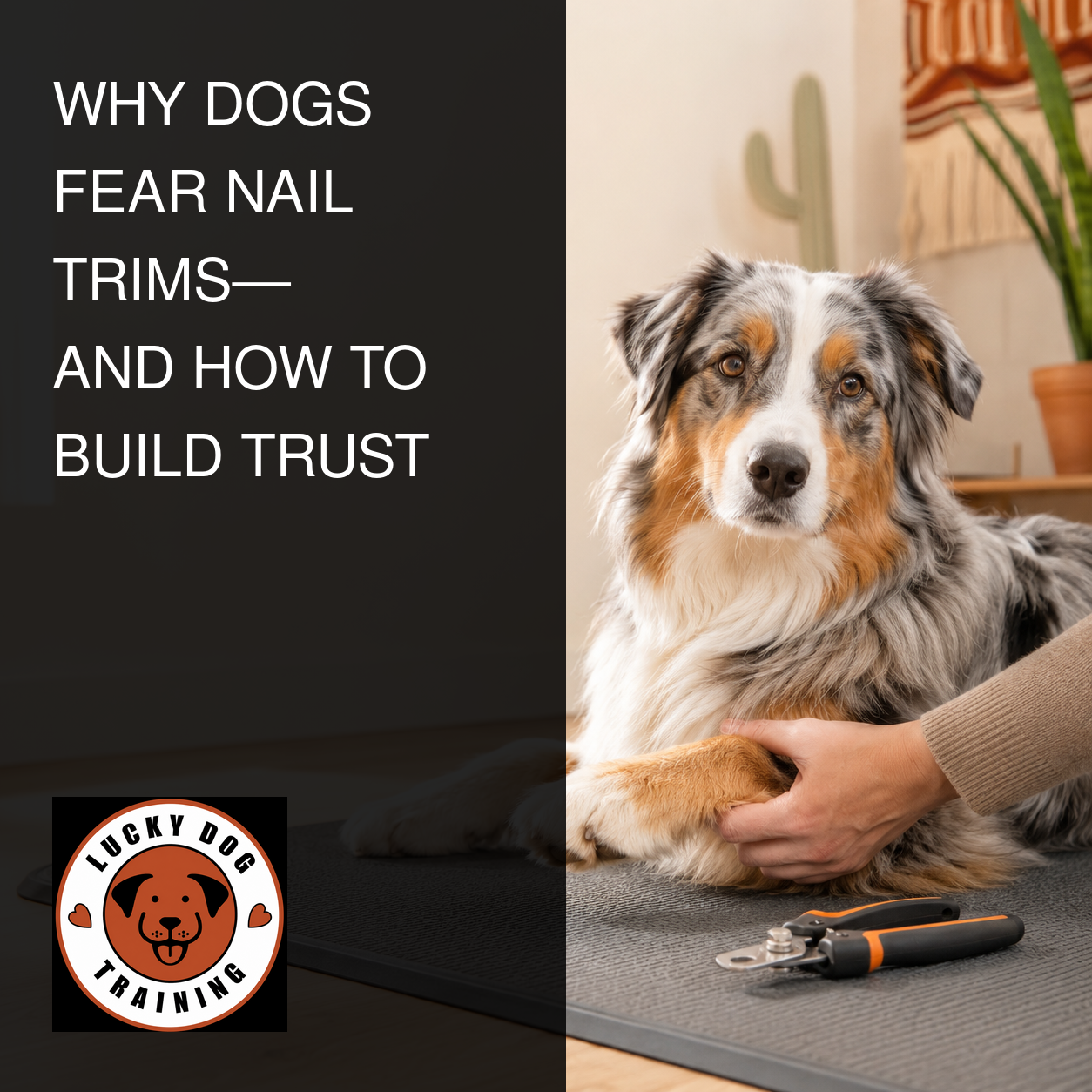
The nail clippers come out, and your dog disappears.
Another dog may stay until you reach for a paw, then pull away, mouth your hand, roll over, freeze, growl, or struggle so intensely that completing even one nail feels impossible.
Owners often describe this as stubbornness or defiance. In many cases, the dog is experiencing fear, physical discomfort, loss of control, or a learned expectation that nail care will involve restraint.
A dog does not need to enjoy every part of nail maintenance. The practical goal is to create enough trust, understanding, and handling tolerance that the dog can participate safely without escalating into panic or aggression.
That requires separating two needs:
The dog’s nails may need timely physical maintenance.
The dog’s emotional response may need a gradual training plan.
Trying to solve both by forcing a complete nail trim can worsen the fear and make every future session harder.
What owners should do first
ANYTIME the steps in our blog posts are out of your ability to follow, or you struggle to facilitate them, contact Lucky Dog Training for professional help. Begin with a professional Behavior Assessment when your dog panics, attempts to bite, cannot be handled safely, or has a history of escalating during grooming.
Ask your veterinarian to examine painful, broken, split, infected, deformed, or suddenly sensitive nails and paws before treating resistance as purely behavioral.
If the nails are dangerously long and cannot wait for gradual training, arrange safe maintenance through your veterinarian or an experienced professional rather than forcing the procedure at home.
Identify the earliest point where your dog becomes concerned: seeing the tool, hearing it, being positioned, having a leg touched, having a paw held, feeling pressure on a toe, or experiencing the actual clip or grinder contact.
Stop setting the immediate goal as “finish every nail.”
Practice brief handling sessions when no nail needs to be cut.
Use secure, nonslip footing and a position that does not make the dog feel unstable or trapped.
If progress stalls, return to professional guidance so Lucky Dog Training can evaluate the handling sequence, owner timing, and home setup.
Why nail care matters
Nails that remain too long can contact the ground abnormally, change how the dog loads the feet, create discomfort, and interfere with walking or running. Dewclaws deserve special attention because they may not touch the ground enough to wear down naturally.
Overgrown nails can curve, split, snag, or grow toward the paw pad. A painful previous tear, a cut quick, or rough handling may also make a dog more protective of the feet.
Regular maintenance is easier when only a small amount needs to be removed. Long intervals can create a cycle in which every appointment becomes a major procedure, the dog struggles, and the next trim becomes even more difficult.
Training is therefore not just about completing today’s nails. It is about developing a sustainable lifetime-care routine.
Fear can begin at different parts of the sequence
“My dog hates nail trims” is not specific enough to build a plan.
A complete nail trim contains many separate experiences:
Approaching the handling area
Standing, sitting, or lying on a surface
Seeing the clippers or grinder
Hearing tools move or switch on
Having a shoulder or hip touched
Having a leg supported
Having the paw held
Feeling individual toes separated
Feeling pressure on the nail
Hearing a clip
Feeling grinder vibration
Remaining in position for repeated nails
A dog may tolerate the first six steps and object to the seventh. Another may accept paw handling but panic when the grinder starts.
Train the first point where comfort disappears—not the entire procedure at once.
Stress signals owners often miss
Resistance does not always begin with growling or snapping. Earlier signs may include:
Turning the head away
Repeated lip licking
Yawning outside a tired context
Closing the mouth suddenly
Lowering the body
Tucking the tail
Pulling one paw back
Shifting weight away
Showing the whites of the eyes
Freezing
Refusing food that the dog normally accepts
Increasing panting
Trying to leave
If those signals do not change the procedure, the dog may learn that subtle communication does not work. The next attempt may produce stronger avoidance, struggling, growling, or biting.
Recognizing early stress gives the handler an opportunity to reduce difficulty before the dog feels forced to escalate.
Do not trick the dog
Spreading food on a surface and cutting a nail while the dog is distracted may appear successful. But if the dog suddenly feels the paw restraint, pressure, or clip, the food can become part of an unpleasant surprise.
Distraction is not the same as changing the dog’s response to handling.
Food can be useful when it follows or accompanies a clearly presented, manageable training step. It should not function as bait that hides what the person is about to do.
The dog should see the tool, experience an easy part of the procedure, and learn that calm participation leads to reinforcement and a predictable release.
Why forced restraint can make fear worse
Holding a struggling dog down, suspending the dog in a sling without conditioning, or having several people overpower the dog may complete the nails that day. It can also teach the dog that paw handling predicts entrapment.
Physical struggle creates safety risks:
The dog may bite.
The handler may cut the quick as the paw moves.
A joint may be twisted.
The dog may fall from a table.
Fear may generalize to grooming, veterinary handling, or ordinary touch.
There are medical circumstances in which a veterinarian must use appropriate restraint or medication to complete urgent care safely. That decision belongs with the veterinarian.
Routine force should not be the training plan.
Make the handling position comfortable
A dog who slips while a paw is lifted may resist because balance feels unsafe.
Use a stable nonslip mat. Consider whether the dog is more comfortable standing, lying on one side, lying in a sphinx position, or offering a paw while seated.
Senior dogs and dogs with arthritis, hip problems, back pain, previous injuries, or weakness may struggle when a leg is lifted too high or held for too long. Veterinary evaluation should come before insisting on a position that may hurt.
Support the limb without pulling it sideways or backward. Keep the first sessions short enough that the dog does not need to fight for relief.
Build paw-handling tolerance before adding tools
Start below the point that triggers avoidance.
For one dog, that may mean touching the shoulder. For another, it may mean briefly resting a hand beside the paw without picking it up.
Progress can include:
Begin with professional and veterinary assessment when appropriate. Contact Lucky Dog Training for fear, unsafe handling, or aggression, and involve your veterinarian when pain or urgent nail maintenance is possible.
Touch the upper leg briefly, then release.
Move gradually toward the lower leg.
Rest a hand around the paw without lifting.
Lift the paw for one second.
Touch one toe.
Apply gentle pressure that resembles the future procedure.
Hold the paw slightly longer only while the dog remains comfortable.
Practice different paws separately rather than assuming one success transfers to all four.
Return to an easier step when the dog pulls away, freezes, refuses reinforcement, or escalates.
Progress is not measured by how much the owner can physically accomplish. It is measured by whether the dog can remain responsive and recover easily.
Introduce the tool as a separate lesson
Do not combine a new handling position, paw restraint, clipper sound, and nail contact in one session.
The tool sequence might include:
Professional assessment first when the dog already fears or reacts aggressively to the tool
Clippers resting across the room
Clippers closer to the dog
The handler picking them up
The tool moving near the dog without touching
Clippers touching the shoulder
Clippers touching the paw
A clipping sound made away from the foot
The tool resting against one nail
One tiny nail-tip removal
A grinder requires separate work with sight, sound, airflow, and vibration. Begin with the tool off and at a comfortable distance. The sound should be introduced far enough away that the dog can remain relaxed.
Never assume a dog comfortable with clippers will automatically accept a grinder, or the reverse.
One nail can be a complete successful session
Owners often create unnecessary pressure by believing every paw must be finished at once.
For a fearful dog, one calm nail may represent far more progress than twenty nails completed through a fight.
End while the dog is still successful. The dog should not learn that cooperation causes the procedure to continue until they can no longer tolerate it.
As confidence improves, progress from one nail to two, then perhaps one paw. The pace should be based on the dog’s behavior, not a deadline.
If the nails are too long to allow that timeline, involve the veterinarian or an experienced nail-care professional for the immediate maintenance while continuing behavior training separately.
Teach a predictable participation behavior
A simple position can help the dog understand when handling begins and when it ends.
Possible behaviors include:
Resting the chin on a towel or the handler’s hand
Standing on a designated mat
Lying on one side
Offering a paw
Holding a stationary position until released
The behavior should be taught away from nail care first.
For example, a chin rest can become a clear start position. The handler briefly touches a leg while the dog maintains the chin rest, then stops and reinforces. If the dog lifts the chin, the handler pauses rather than immediately pursuing the paw.
This makes the interaction more predictable and gives the handler useful information about the dog’s comfort.
It does not mean the dog controls whether necessary medical care ever occurs. It means routine training is structured to build willing participation instead of repeated conflict.
Can a scratchboard help?
A scratchboard can help some dogs file the front nails through a trained pawing motion. It may be especially useful while clipper or grinder tolerance is developing.
It has limitations:
Dogs may wear the center nails more than the outside nails.
Rear nails may require a different setup.
Dewclaws will not be filed by ordinary scratching.
Excessive repetitions can abrade the paw pads or shorten nails unevenly.
The dog still needs handling tolerance for veterinary care and inspection.
Use a scratchboard as one tool within a complete nail-maintenance plan, not as a reason to avoid all foot handling.
Clippers versus grinders
Neither tool is automatically best for every dog.
Clippers are fast and quiet, but they create pressure and a sudden clipping sensation. Dull or poorly sized clippers may crush or split the nail.
Grinders remove smaller amounts gradually and can smooth edges, but they introduce noise, vibration, warmth, and moving equipment. Hair near the foot can become caught if it is not managed safely.
Owners must know how to identify the quick, especially in dark nails, and how to use the chosen tool correctly. If you are uncertain about technique, ask a veterinarian or experienced professional to demonstrate.
Behavior training cannot compensate for painful or unsafe equipment use.
What if the quick was cut?
Cutting into the quick can cause pain and bleeding and may create a lasting negative association.
If it happens, remain calm and follow veterinary guidance for controlling the bleeding. Contact your veterinarian if bleeding continues, the nail is badly damaged, the dog is in significant pain, or you are uncertain about the injury.
Do not immediately continue cutting the remaining nails to “get it over with.” Address the injury and allow the dog to recover.
Future training may need to return to easier handling and tool steps before another nail is trimmed.
Medication is a veterinary decision
Some dogs experience fear severe enough that a veterinarian may recommend medication for safe, humane nail care while behavior work continues.
Do not give human sedatives, cannabis products, supplements, leftover prescriptions, or another animal’s medication. The appropriate drug, dose, timing, interactions, and health risks must be evaluated by a veterinarian.
Medication should not be treated as a training failure. In serious cases, reducing panic may make safe maintenance possible and support better learning.
It also should not replace the long-term handling plan when training is feasible.
Common mistakes that slow progress
Waiting until nails are severely overgrown
Urgency encourages owners to rush. Frequent maintenance and training between trims reduce the pressure to complete a large amount at once.
Practicing only when the tool appears
Paw handling should occur in short, structured sessions when nothing will be clipped.
Repeating the procedure after the dog has said no
Chasing the dog and immediately trying again can increase avoidance. Reduce the difficulty and rebuild from the last successful step.
Moving too quickly because treats are accepted
Eating does not always mean the dog is comfortable. Watch posture, breathing, muscle tension, paw withdrawal, and the dog’s ability to remain engaged.
Allowing every person to use a different method
One person lifts the paw gently; another grabs and holds; another attempts to trim during sleep. Inconsistency makes the procedure less predictable.
Punishing growling
Growling communicates discomfort. Punishing the warning may suppress it without changing the fear, leaving the dog more likely to bite with less warning.
A two-week foundation plan
This plan builds handling readiness; it is not a promise that every fearful dog will be ready for a full trim in two weeks.
Arrange professional and veterinary assessment first when needed. Do not begin unsupervised handling exercises with a dog who may bite, has painful paws, or urgently needs overgrown nails addressed.
Choose a comfortable nonslip location.
Identify the first handling step the dog accepts without avoidance.
Practice that step for only a few repetitions.
Teach a stable participation behavior such as a mat position or chin rest.
Introduce the tool visually without touching the paw.
Add one variable at a time: tool movement, sound, paw contact, nail contact, then a tiny trim.
Stop before the dog becomes overwhelmed.
Record which paws, positions, and tools are easiest.
Ask Lucky Dog Training to reassess the plan if progress stalls or the dog’s response worsens.
Start with a professional consultation
Nail-care resistance can involve fear, pain, balance, handling history, equipment, restraint, owner timing, and the dog’s understanding of the procedure.
Lucky Dog Training begins with a professional Behavior Assessment and consultation pathway. We evaluate the earliest trigger, the dog’s warning signals, response to touch, position preferences, owner handling, and whether veterinary involvement is needed.
Programs may include Private Lessons, Day Training, Train and Play, or Extended Training. Work can address paw handling, Hold, Place, cooperative positioning, impulse control, tolerance for tools and sounds, owner timing, and recovery from stress.
The best part: Lucky Dog Training provides Follow-Up Sessions AT YOUR HOME no matter which training program you choose.
Nail-care behavior is influenced by the dog’s actual floor surface, handling position, equipment, household routine, and the people performing the procedure. In-home follow-up allows us to adjust those exact details and help the dog transfer training into their normal care routine.
Schedule your consultation first through LuckyDogTrainingPS.com.
If these steps exceed your ability, your dog’s fear is escalating, or completing nail care has become unsafe, begin with professional assessment instead of repeating another forced attempt.
Lucky Dog Training serves Palm Springs, Palm Desert, Rancho Mirage, Cathedral City, La Quinta, Indio, and surrounding communities throughout The Coachella Valley. Broader service areas include Riverside, San Diego, and Los Angeles counties across Southern California.
If you or someone you know needs practical help creating safer, calmer handling and grooming behavior, please share Lucky Dog Training.