
When One Dog Reacts and the Other Dog Pays: Redirected Aggression in Multi-Dog Homes
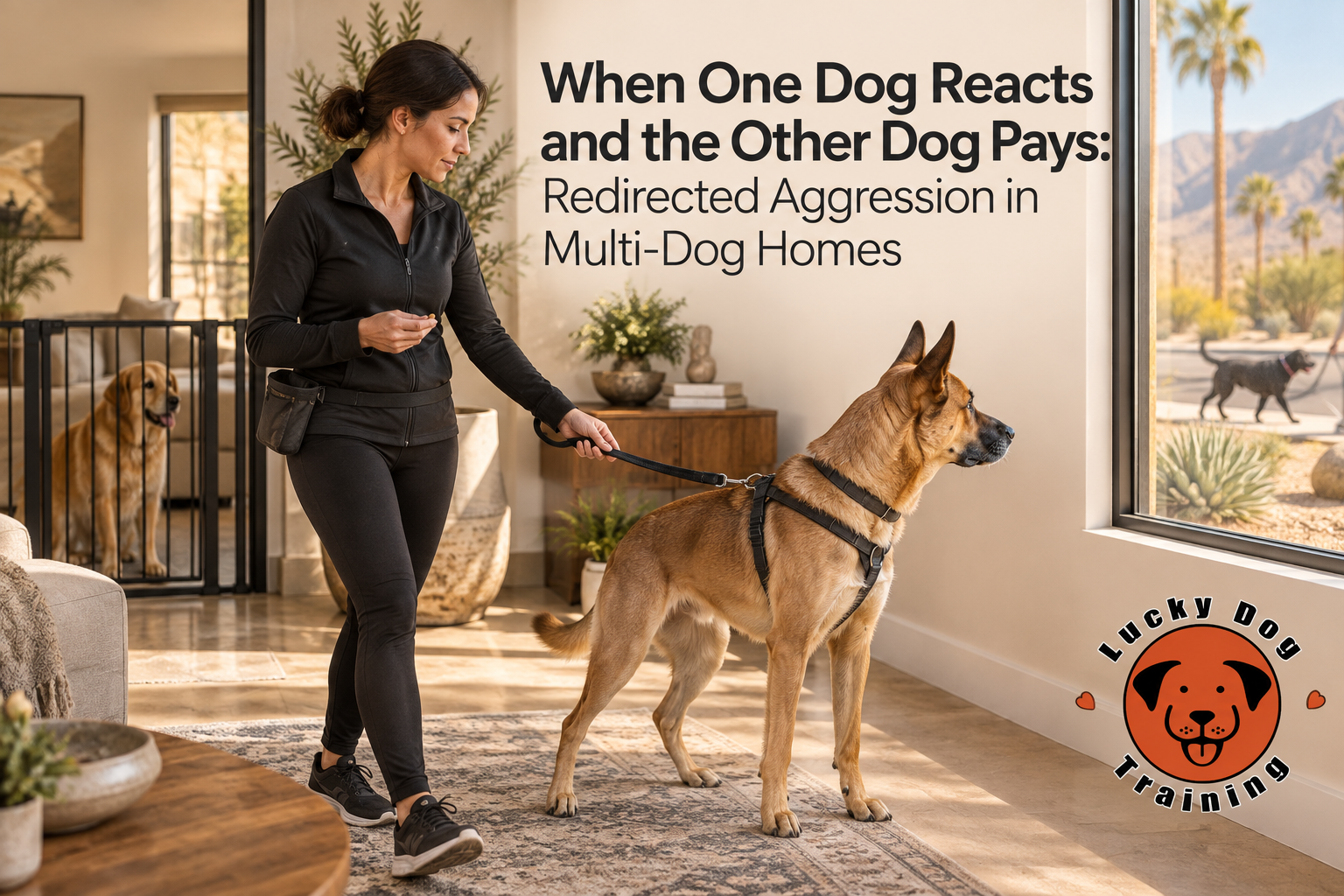
A dog races to the window when another dog passes. Its housemate follows. Both begin barking, bodies collide, and within seconds the dogs that normally share beds and toys are fighting each other.
The owner may conclude that the relationship suddenly collapsed.
Sometimes household conflict is involved. In other cases, however, the nearby dog was not the original target at all. One dog became intensely aroused by something it could see or hear but could not reach, then redirected that energy toward the closest available animal.
This is redirected aggression. It can happen quickly, cause serious injuries and become more likely when dogs repeatedly rehearse the same high-arousal pattern.
The solution is not to let the dogs “work it out.” It begins with separation, accurate assessment and preventing the next incident.
What Is Redirected Aggression?
Redirected aggression occurs when a dog directs aggressive behavior toward someone or something other than the original trigger.
For example:
A dog sees another dog outside the window.
The window prevents physical access.
Frustration and arousal continue rising.
A household dog approaches, barks or bumps into the first dog.
The first dog turns and attacks the nearby dog.
VCA describes this pattern as a highly aroused or frustrated dog losing focus on the original target and redirecting toward a nearby person or companion animal. VCA Animal Hospitals
The housemate may have done very little to provoke the incident. Proximity, movement or accidental contact can be enough when the reacting dog is already near its limit.
Redirected aggression does not automatically mean the dogs hate each other. It does mean the situation is unsafe and deserves to be taken seriously.
Common Setups in Multi-Dog Homes
Redirected incidents frequently occur around:
Windows overlooking sidewalks
Walls and fences beside walking paths
Front doors when guests or deliveries arrive
Yard gates
Barking dogs on neighboring properties
Wildlife entering the yard
Dogs passing a parked vehicle
Leash restraint during a reaction
Excited loading or unloading from a car
Multiple dogs rushing through a doorway
Fence-running
Sudden noises that activate both dogs
One dog attempting to join another dog’s reaction
Barrier frustration can intensify behavior because the dog can detect the trigger but cannot approach, investigate or drive it away. Territorial responses may also become more intense behind windows, fences and gates. VCA Animal Hospitals
Not every household fight is redirected aggression. Conflict over food, toys, resting locations, attention or access to doorways may involve resource guarding or competition. Pain, illness and changes in social maturity can also affect relationships.
Correct identification matters because different causes require different plans.
Professional Help Should Come First After a Serious Incident
If either dog has bitten, punctured, pinned or repeatedly attacked the other, seek direct assistance from a qualified professional trainer or behavior specialist before recreating the situation.
Professional guidance is especially important when:
A person was bitten while intervening
One dog is physically capable of seriously injuring the other
Fights are becoming more frequent or intense
The dogs cannot be moved safely
Warning signals are difficult to recognize
Aggression occurs without an obvious trigger
Children or vulnerable adults live in the home
The dogs continue seeking each other after separation
One dog appears chronically afraid of the other
Previous reunions have caused another fight
Use secure physical separation until a plan is in place. Depending on the dogs, this may require closed doors, crates, exercise pens, gates or more than one barrier.
A gate alone is not adequate if either dog can jump it, knock it down or fight through it.
Do Not Put Your Hands Between Fighting Dogs
People are commonly bitten when they grab collars, reach between dogs or place their faces and arms close to the conflict.
During a fight:
Keep children and bystanders away.
Do not reach between the dogs.
Do not grab near their heads.
Do not strike, kick or scream into the conflict.
Use available barriers and distance to protect people.
Follow an emergency separation plan previously developed with a qualified professional.
Obtain emergency assistance when the dogs cannot be separated safely.
There is no universal fight-interruption method that is safe for every combination of dogs, people and surroundings. Advice that appears simple online can expose an owner to a redirected bite.
The Centers for Disease Control and Prevention notes that any dog can bite, particularly when frightened, nervous, protecting something or engaged in intense activity. Nearly one in five people bitten by a dog requires medical attention. Centers for Disease Control and Prevention
Human safety comes first.
What to Do Immediately After an Incident
Once the dogs are separated, do not force an immediate reunion to see whether they are “over it.”
Instead:
Place the dogs in separate, secure spaces.
Block visual access if seeing one another maintains agitation.
Allow sufficient time for both dogs to recover.
Examine each dog without putting yourself at risk.
Contact a veterinarian about punctures, swelling, limping or pain.
Photograph visible injuries.
Record what happened before the incident.
Note the location, trigger, distance and sequence of behavior.
Arrange professional evaluation before repeating the setup.
Punctures can be difficult to see beneath the coat, and a small surface wound may conceal deeper tissue damage. A veterinary examination is appropriate after a significant bite.
Sudden aggression also warrants medical evaluation. Pain, sensory changes, neurologic problems and other health conditions can alter tolerance and behavior.
Learn the Escalation Sequence
A redirected attack may appear to happen without warning because owners notice only the final turn toward the second dog.
Earlier signals may include:
Sudden fixation
A closed mouth
Forward weight
A high, rigid tail
Stiff legs
Hard staring
Rapid scanning
Frantic barking
Repeatedly striking the window or fence
Ignoring familiar commands
Spinning toward nearby movement
Body-slamming the housemate
Growling when the other dog approaches
Increasing leash pressure
An inability to move away from the trigger
The safest time to intervene is before the dog reaches peak arousal.
Waiting until two dogs are crowded together at the window, barking at full intensity, leaves very little room for communication.
Prevent Rehearsal
Every uncontrolled repetition strengthens the pattern and creates another opportunity for injury.
Management may include:
Applying privacy film to problem windows
Closing blinds before high-traffic periods
Moving furniture away from windows
Using solid visual barriers along fences
Supervising yard access
Taking the dogs outside separately
Preventing both dogs from charging the front door
Confining one dog before opening an exterior door
Using separate stations during deliveries
Keeping leashes accessible for planned transitions
Moving dogs away from gates before visitors enter
Preventing fence-running
Using white noise where predictable sounds activate the dogs
Separating the dogs during known wildlife activity
Management is not an admission that training has failed. It prevents another dangerous rehearsal while training is developed.
VCA’s safety guidance recommends physical barriers and controlled handling when aggression is possible, with freedom provided only under capable adult supervision. VCA Animal Hospitals
Teach Each Dog Separately First
Do not begin by training both dogs together beside the trigger.
Each dog should first understand useful behaviors independently, including:
Coming away from a window or fence
Responding to its name
Recall
Place
Down
Waiting behind a boundary
Moving in the handler’s direction
Leaving another dog’s space
Remaining stationary while a door opens
Settling after excitement
Begin in a quiet setting. Add modest distractions only after the command is understood.
A useful “away” exercise can teach the dog to turn from a boundary and move with the handler. Reinforcement may include food, praise, access to another room, appropriate play or release to a calmer activity.
Deliver reinforcement after the correct response whenever possible. Constantly displaying food before giving direction can cause the dog to evaluate the offer while remaining fixated on the trigger.
Train Below the Explosion Point
Once foundational commands are reliable, carefully introduce manageable versions of the problem.
That might mean:
Working with one dog while the other remains securely separated.
Beginning far from the problem window or fence.
Using a predictable, low-intensity distraction.
Interrupting the first signs of fixation.
Directing the dog to a known location or movement pattern.
Reinforcing disengagement and recovery.
Ending before arousal becomes uncontrolled.
Change one variable at a time.
Do not simultaneously decrease distance, add both household dogs, increase movement and extend duration.
Training is productive when the dog can notice the trigger and still respond. A dog slamming into a window and attempting to bite whatever moves nearby is no longer in an appropriate owner-directed practice session.
Where Balanced Training Fits
Balanced training recognizes that reinforcement, boundaries, management and consequences all have roles—but timing and judgment determine whether they are useful.
If a dog understands “away,” remains capable of responding and knowingly returns to a prohibited window, fair leash guidance or an appropriate correction may be necessary.
That intervention should:
Address a command the dog already understands
Occur before arousal becomes extreme
Interrupt the unsafe choice
Direct the dog toward a known behavior
End when the dog complies
Be appropriate for the individual dog
Be followed by acknowledgment of the correct response
Never become an emotional reaction from the handler
Correcting a dog at the peak of frantic aggression can add conflict, increase arousal or cause the dog to redirect toward the handler or housemate. VCA cautions that confronting a highly aroused dog can increase the risk of redirected aggression. VCA Animal Hospitals
The answer is not to ignore dangerous behavior. It is to intervene earlier, maintain control and avoid placing hands or bodies within reach of an aroused dog.
Fair accountability requires prior understanding and a dog that remains capable of making a different choice.
Do Not Punish the Warning Out of the Dog
Growling, freezing and turning away are information.
Punishing those warnings without changing the underlying situation may produce a dog that still feels conflict but provides less notice before biting.
A warning should prompt the handler to:
Increase separation
End crowding
Remove the trigger where possible
Reestablish physical control
Evaluate what raised arousal
Return to a manageable exercise
Seek professional guidance if the pattern is recurring
This does not mean growling should control the entire household. It means the owner should recognize what it indicates and address the complete behavior rather than merely silencing the sound.
Reintroductions Must Be Deliberate
After a fight, owners may place the dogs together because they appear calm through a gate. That can be misleading.
A safe reintroduction plan may involve:
Veterinary clearance
Separate decompression
Secure equipment
Two capable handlers
Parallel movement at an appropriate distance
Avoidance of the original trigger
Short, controlled sessions
No high-value resources present
Observation of both dogs’ complete body language
Immediate separation if tension returns
A basket muzzle may be part of a professional plan, but it does not make an unsafe interaction safe by itself. It must be correctly fitted and conditioned, allow panting and drinking, and never be used to force proximity.
Some dogs resume normal cohabitation with careful work. Others require long-term separation during specific events. In severe cases, permanent management or a different living arrangement may be the most responsible choice.
Safety matters more than proving the dogs can share every space.
Consider the Whole Household Relationship
Redirected aggression may reveal a problem around a specific trigger, but existing tension can make the outcome more severe.
A professional assessment should consider:
The dogs’ ages and social maturity
Size and strength differences
Sex and reproductive status
Pain and medical conditions
Resting-space conflict
Food and toy guarding
Competition for human attention
Doorway and hallway pressure
Changes in hearing or vision
New animals or people in the home
Previous fight history
Recovery after stressful events
Do not label every fight “redirected” simply because an outside dog was present. The trigger may have started the incident while an unresolved household conflict influenced what happened next.
Coachella Valley Management
Coachella Valley homes can present specific challenges:
Block walls that conceal approaching dogs until they are close
Golf-course paths beside yards
Frequent delivery activity
Coyotes, rabbits and other wildlife
Dogs passing with seasonal visitors
Courtyards and narrow gates
Large windows facing community walkways
Inspect the property from the dog’s perspective. Determine where outside movement becomes visible and where two dogs are likely to crowd together.
Use indoor, climate-controlled separation when possible. Do not solve fence aggression by leaving one dog outside in desert heat. During warm conditions, training sessions should remain brief and should never interfere with cooling, water or physical safety.
Prevention Protects the Relationship
Redirected aggression can damage trust between dogs that previously lived together comfortably. The dog that was attacked may begin avoiding the other dog, guarding doorways or reacting defensively when arousal rises again.
Prevention protects both dogs.
The objective is to create a household in which:
Triggers are managed before the dogs rush them
Each dog responds independently to the handler
Doorways and boundaries have clear rules
High-arousal events do not involve both dogs
Reinforcement supports calm disengagement
Known commands have meaningful follow-through
Recovery happens before the dogs interact again
Medical and behavioral concerns are addressed promptly
Redirected aggression is not solved by deciding which dog is “dominant” or allowing another fight to settle the issue. It is solved by understanding the sequence, preventing access to rehearsed setups and teaching each dog how to leave the trigger under reliable direction.
ANYTIME the steps in our blog posts are outside your ability to follow, or you struggle to facilitate them safely, seek direct assistance from a qualified professional. If your dogs have fought, caused punctures, redirected toward a person or cannot be separated safely, keep them securely apart and obtain qualified training and veterinary guidance before attempting another interaction.
Go Beyond the Blog
For deeper education, practical challenges, coaching content and ongoing support grounded in real-world balanced dog training, join Canine Lifestyle on Patreon: